Concepts:One of the points of this course is that things change. Specifically, technology changes. The American Heritage dictionary offers a couple of interesting definitions:
The first one is a bit arrogant, isn't it? It assumes we are talking about only one kind of technology that the second definition offers a hint about. There are many kinds of technology that do not relate to "electronic and digital products". Since this class is about trends in computer science, we may be most interested in technologies that relate to electronics, but we should recognize other types, too. Dictionary.com offers another definition that is a bit wider:
This one says that technology is about creating and using
things, and that it has effects on parts of life that, historically, were
not considered to be involved with technical matters. Is this a new development,
or has it always been true?
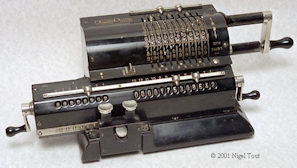
Instead, mechanical computing was implemented in more limited forms that were more affordable, and therefore more profitable: adding machines and calculators. (Odhner,in the late 1800s, lower left, and Burroughs, in the mid 1900s, lower right.) Babbage's concepts were reflected in the development of electronic computers, which came later.
Invention of electronic computing devices started around the time of
World War II. There was a military need to create devices that could calculate
solutions to ballistic problems rapidly, which led the US Army to sponsor
the creation of
ENIAC, the first fully electronic computer. Watch the video behind
that link, and you will probably agree that what we call a computer was
not invented at one time. It is an idea that has been developed over time.
It has evolved from a concept into a number of kinds of
devices that most people can recognize and use. That evolution
of the idea has not stopped. It continues to change in form and
in purpose. Technology has always been on path of improvement.
Sometimes the improvements have to wait for supporting technology
to exist. Babbage could have built his computer if he had secured funding,
but he could not have built ENIAC, much less a laptop, because
he did not have the necessary technology to make the components to build
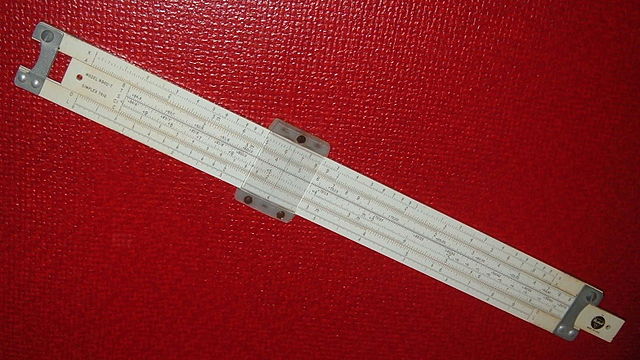
such a device. New concepts are theorized, then developed, and combinations of new developments make other developments possible. Everything starts with an idea, but it's the development and implementation of an idea that can change everything for the people who use it. Ideas become technology. When it works and has value, technology is used to create tools and products, which in turn become more available or more useful technology. Using technology changes what we can do and, sometimes, what we believe we are. Let's go back to that point I told you we would revisit. A slide rule is a fine device. It takes no power to use it, it only takes the skill to manipulate the slide and the cursor (that's what we called the clear part that shows where to read the answer), and the practiced ability to read the answer and figure out where to put a decimal point. I learned to use a slide rule in junior high school (7th grade), and used one my first year in college. That was in 1972. The following year, Texas Instruments marketed the SR-10 and SR-11 calculators. There were other electronic calculators before them, but these were affordable electronic calculators that would give you an answer with no need to figure out the decimal point placement, and would do it with more degrees of precision than you would be able to read on a slide rule. They cost more than a slide rule, but anyone could use one. A good slide rule could do more, but most people only used a few functions of their slide rules, and an SR-11 had those. And that made calculators consumer electronics, not business machines, which changed everything. We live in an age that has technology that would seem miraculous, not just to our remote ancestors, but to our grandparents. People have probably always felt this way about the innovations they are enjoying, but we are on a curve of technological improvement that is becoming steeper. Consider this list of inventions and inventors. Take a look at how long ago some concepts were theorized, and how long it took to make a technology that used them. Then consider how long it has taken to create and improve non-electronic devices that you use every day. Then think about how many improvements you have seen in electronic devices over your life, and over the last ten years. In the discussion above, I have tried to give you some perspective on technology and its place in history. One of the goals of this course is to guide you in technical research to answer some basic questions about technology, education, and making choices about the technology we use in our jobs and our lives. Let's consider some of the essential questions that go with this course. For the first two assignments, we will use the material above, and consider history. This will be practice, in a sense, for the mid-term project which will be due in week five. It has the following requirements:
|